
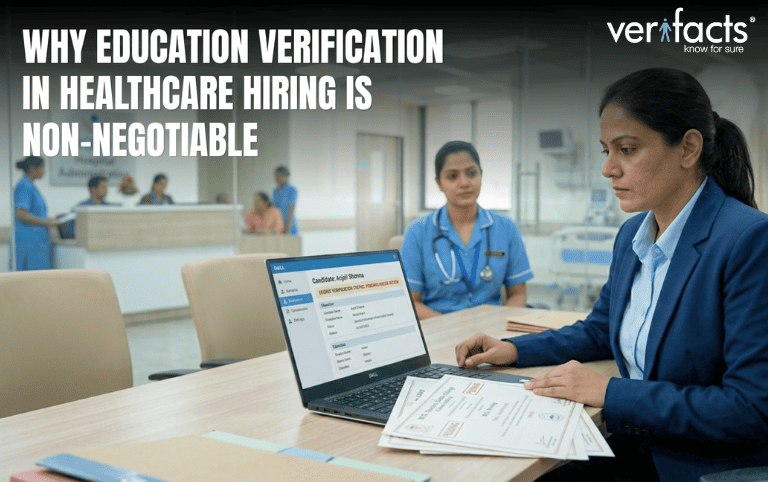
In healthcare, trust is not built in the interview room. It is built on verified credentials.
Because when a hospital hires a doctor or nurse, it isn’t just filling a role, it is placing patient lives, institutional credibility and legal responsibility in their hands.
And sometimes, what looks qualified on paper isn’t qualified at all.
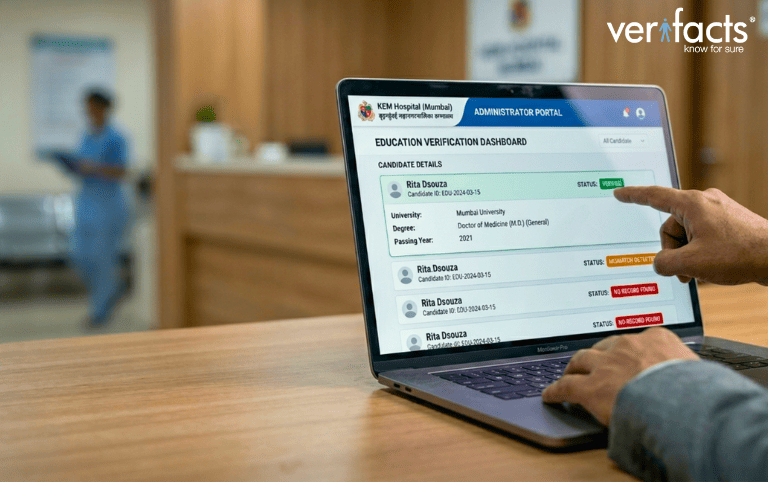
A Case That Should Never Happen, But Did.
A mid-sized hospital on boarded a nurse during a high-demand hiring phase.
Her resume was impressive:
● recognized nursing degree
● prior hospital experience
● clean documentation
Everything checked out, at least on the surface.
Weeks later, inconsistencies began to emerge. Basic procedures were mishandled. Documentation errors increased. Supervisors noticed gaps
in fundamental clinical knowledge.
An internal review was initiated.
The result?
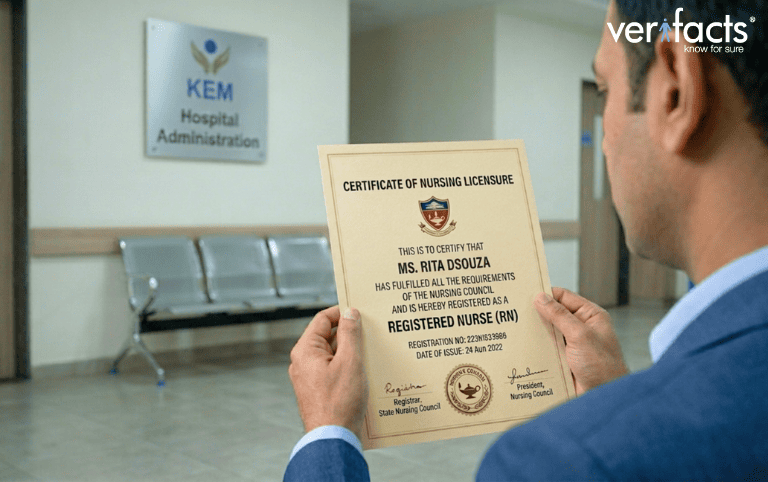
👉 The nursing degree was fabricated.
👉 The institution listed on the resume had no record of her enrollment.
👉 Previous employment details were unverifiable.
By the time this was uncovered, the damage had already begun.
The Real Cost of an Unverified Qualification
This wasn’t just a hiring mistake. It was a systemic failure of verification.The consequences escalated quickly:
● Patient Safety Risks
Improper procedures led to near-critical incidents.
● Legal Exposure
The hospital faced potential negligence claims.
● Regulatory Scrutiny
Authorities initiated compliance checks.
● Reputational Damage
Trust from patients and stakeholders was impacted.
In healthcare, the margin for error is zero. And yet, one missed verification created a cascade of risk.
Why Education Fraud Is a Growing Threat

Credential fraud in healthcare is not rare, it is evolving.
Candidates today can:
● Forge degree certificates
● Misrepresent institutions
● Manipulate digital records
● Present unverifiable international qualifications
And in high-pressure hiring environments, surface-level checks often fail to detect these gaps.
Where Most Hiring Processes Fall Short
Many organizations still rely on:
1. Document-Based Verification
Accepting certificates without validating them from issuing authorities.
2. Delayed Checks
Verification conducted after on boarding increases immediate exposure.
3. Fragmented Processes
No unified system to validate education, identity and history together.
4. Assumption-Based Hiring
Trusting credentials because they “look legitimate”.
From Hiring to Risk Management
Education verification in healthcare must move beyond compliance. It must become a risk control mechanism.
This means:
● Validating degrees directly with universities and boards
● Confirming licensing and certifications with regulatory bodies
● Identifying inconsistencies before on boarding
● Lintegrating verification into hiring workflows, not after them
Because in healthcare, verification is not a step. It is a safeguard.
How Verifacts Strengthens Education Verification
With solutions like VIBE 2.0 by Verifacts Services Pvt Ltd, healthcare organizations can:
● Verify educational credentials directly from source authorities
● Detect falsified or unverifiable qualifications early
● Integrate verification seamlessly into on boarding workflows
● Maintain speed without compromising accuracy
The result?
👉 Faster hiring
👉 Stronger compliance
👉 Reduced legal exposure
Conclusion
The degree looked real. But the risk was hidden.
In healthcare hiring, a single unverified credential can lead to consequences far beyond operations, it can become a legal, ethical and safety crisis.
The difference between trust and risk is not judgment. It is verification.
